November Highlights: Barcelona & Bilbao

Updated: Nov 30, 2023
Hello again!
This month, I've finally transitioned out of "vacation mode". The initial strangeness of the move has worn off, and the reality of being an adult with my first post-college job is setting in. Somewhere between paying the first utility bill and applying for a residency card, it sunk in that this is my real life, not a holiday. So I settled into a solid routine of lesson plans, work, and a few adventures.
Barcelona
I took a quick weekend trip to beautiful Barcelona, a vibrant city that fully lives up to the hype. It's located in Basque Country's neighbor, Catalonia, another region that also has a local language and culture distinct from mainstream Spain. But even from that, Barcelona is totally different. Over time, it has become an icon of a city, attracting expats, tourists, and Spaniards from diverse backgrounds to create what can only be described as an international city with a unique character of its own. Perhaps its singularity is what sets it apart on a global level. First stop: Barrio del Born, a popular neighborhood with picturesque, medieval streets, chic artesian shops, and trendy cocktail bars and cafés. It's also home to the Cathedral of Barcelona, which is currently exhibiting a strangely secular advertisement for smartphones. My favorite spot? Especiarium Bar, a specialty cocktail bar that designs drinks based on exotic spices such as wasabi. My choice was not so risky and basically tasted like a spicy lemon milkshake.
Next stop, all the usual haunts. They might seem basic, but some things are simply touristy for good reason. And I include the following in that category. First, the Arc de Triomf, which towers over the city as a sort of welcome gate, was originally built for the 1888 Barcelona World's Fair and has remained a longstanding staple of the city. Pass through this looming tunnel to discover Gaudí's architectural treasures, including La Pedrera, Casa Batlló, Parc Güell, and most famously, La Sagrada Familia. Atoni Gaudí's work effectively redefined modernism and changed the face of Barcelona. His work is colorful yet natural, reflecting shapes found in the natural world that still tend to stretch the imagination.
La Basilica de la Sagrada Familia is the most-visited destination in Spain, and for good reason, as there is simply no other building, church or otherwise, like it in the world. It's been under construction since 1882 and is set to finish in 2026, 100 years after the death of its creator. It's enormity gives it several facets, each more visually interesting than the last. Its front side resembles an elaborate sand castle, while its sides depict colors, fruits, and flowers from the Creation story. The columns of the backside were made to look like stressed muscles and tendons, representing Jesus's pained body in death. The basilica's sheer size and immaculate design are enough to make even the greatest of heathens (me), feel something akin to awe.
Gaudí's other iconic creation is Parc Güell, a huge privatized park composed of natural gardens and distinctive architectural landmarks such as Casa del Guarda (the gingerbread house) and the Hypostyle Room, where you can get lost among imposing white columns and colorful mosaic spirals. Here is where you can really feel Gaudí's art come alive, as you are, in fact, walking through it, touching it, living it. Parc Güell really allows visitors to experience Gaudí's art in a closer, more personal way.
To close the night, Parc Güell's slightly grungier neighbor, the Carmel Bunkers, is an ideal spot to watch the sunset. The Bunkers were originally used during the Spanish Civil War to store artillery and protect the city from aerial attacks. Now the ruins of the walls can be found covered in locals and tourists alike who make hike up to the top (usually with some beverages and snacks) to catch a panoramic view of Barcelona.
Last stop: Breakfast at La Boquería Market, a large market near the La Rambla, selling a wide variety of Catalan food products. For fairly cheap prices, you can buy anything from individual fruit cups to entire legs of Iberian ham. Personally, I enjoyed the empanadas and spiral potato chips. But the must-try delicacy here is catánies, a traditional Catalan sweet (pictured below in my hand), which taste absolutely heavenly. They are traditionally made by coating Marcona almonds in chocolate and cocoa powder, but the Boquería also offers flavors like coconut, Catalan cream, and dulce de leche. These candied nuts tend to be more expensive, but totally worth it.
Food
Okay, just a little more nerding-out over food. It's hard not to in Spain! Pictured below in order from left to right:
Rabas - fried squid, traditionally served as a pintxo on Sundays.
Fideuá - a Catalan take on paella, traditionally served with seafood or chicken (mine was vegetarian), and with short noodles instead of rice. I got to taste this delicious meal at a street market in Barcelona.
Churros and hot chocolate - a Spanish dessert staple, especially at Christmastime. However, the churros are not coated in cinnamon and sugar like at home. Instead, they are essentially fried dough lightly coated with sugar, served with thick, dark chocolate (not milky hot cocoa like in the States!). Some people don't like how rich and dark the melted chocolate is here, but I personally love it, probably a little too much. Photos are from La Pallaresa churros&chocolate shop in Barcelona, where I had the BEST churros of my life.
Carolinas - the yellow spiral dessert featuring the Basque flag is a carolina, the unofficial official dessert of Bilbao. A fluffy cone of merengue sits atop a custard-filled biscuit base to create an iconic (and quite photogenic) treat.
Pintxos - Last but certainly not least, Basque country is known for its delectable pintxos, small bar snacks, usually served on or with a piece of bread. These particular pintxos are from La Ribera Market in Bilbao, a riverside cafeteria of some of the area's best pintxos. On this plate: a chorizo bocadillo, a mushroom croquette, and melted Idiazabal cheese on bread.
Bilbao
This November, I really made an effort to explore Bilbao as much as possible. It's a beautiful, underrated city with so much to offer. As much as I enjoyed my trip to Barcelona, I couldn't really imagine myself living there. Like it or not, I'm a Kentucky girl at heart and I enjoy the pace and charm of smaller cities. Living in Bilbao also makes me feel like I'm getting a more local authentic experience, since the number of British and American tourists is substantially lower than in cities like Madrid or even San Sebastián. That being said, Bilbao still sees a fair amount of local and international tourism. (If I'm feeling homesick, I just walk by the Guggenheim and usually hear a fair amount of English being spoken.) Featured below in order from left to right: City Hall, Plaza Nueva, San Antón Eliza Church, Nervión River, La Ribera Market, and buildings and street art from several charming Bilbao neighborhoods.
Fun fact: Pierce Brosnan "jumped" out of the window of the building in the last picture as James Bond in The World is Not Enough (1999). The Guggenheim and Puppy, one of its most famous works, are also seen in the film.
I'm lucky to live in a great riverside neighborhood, Uribarri, which connects to the city center, Abando, just across the Nervión River via 2 iconic bridges: La Salve (red) and Zubizuri (white).
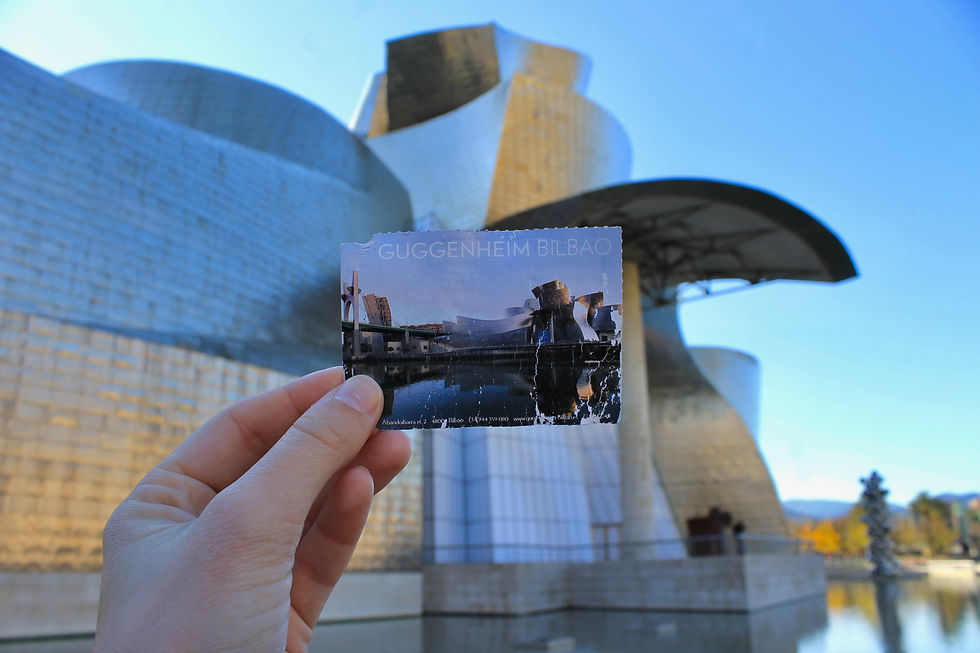
Another classic spot in Bilbao, the Guggenheim Art Museum, just celebrated its 25th Anniversary. The construction of the Guggenheim brought a community of artists and a substantial increase in tourism to the city, transforming this formerly industrial town into a top destination in northern Spain. Its trusty guard dog, Jeff Koons's Puppy, keeps watch over the front entrance while Maman, a spiderlike structure, haunts the back.
In Uribarri, you can also find el Funicular de Artxanda, a cable car that delivers passengers to the top of Mount Artxanda. Here you can find a lovely park and sweeping views of Bilbao and the surrounding mountains. It's also home to the fingerprint sculpture pictured below. It was inaugurated in 2006 as a homage to those who died protecting Basque Country during the Spanish Civil War. The tribute acknowledges not only the dead, but the survivors. It honors the living who went on to raise their families in the midst of loss and oppression while keeping their memories and cultural identity alive.
And just a metro ride away from Bilbao, there are several gorgeous beaches. While it's a little further out than some, Playa Sopelana is still my favorite. It's flanked by rugged rock formations and lush green cliffs that overlook the now-frigid ocean. Come for the scenery, stay for the waves! This beach is a really popular spot for surfers (and those of us who enjoy cheerleading from a dry spot).
Aux-Giving
Even though I couldn't be home for Thanksgiving this year, I got to celebrate with my fellow Americans here in Spain! My friends hosted a lovely Friendsgiving party, complete with turkey and all the fixings. While I can't exactly brag about my contribution (2 baguettes from the neighborhood bakery), I can say that I feel very grateful my new friends are such good cooks!
Cheers to a great November and wishing all who read an even better December.
Agur,
Julia
P.S. Subscribe with your email below if you want to stay updated!


Two baguettes - that was funny! Glad that you are enjoying this so much and thanks for sharing. A KY girl on a great journey - keep it up and best of luck!!